Articles · 2 November 2026 · Lucy Pitt
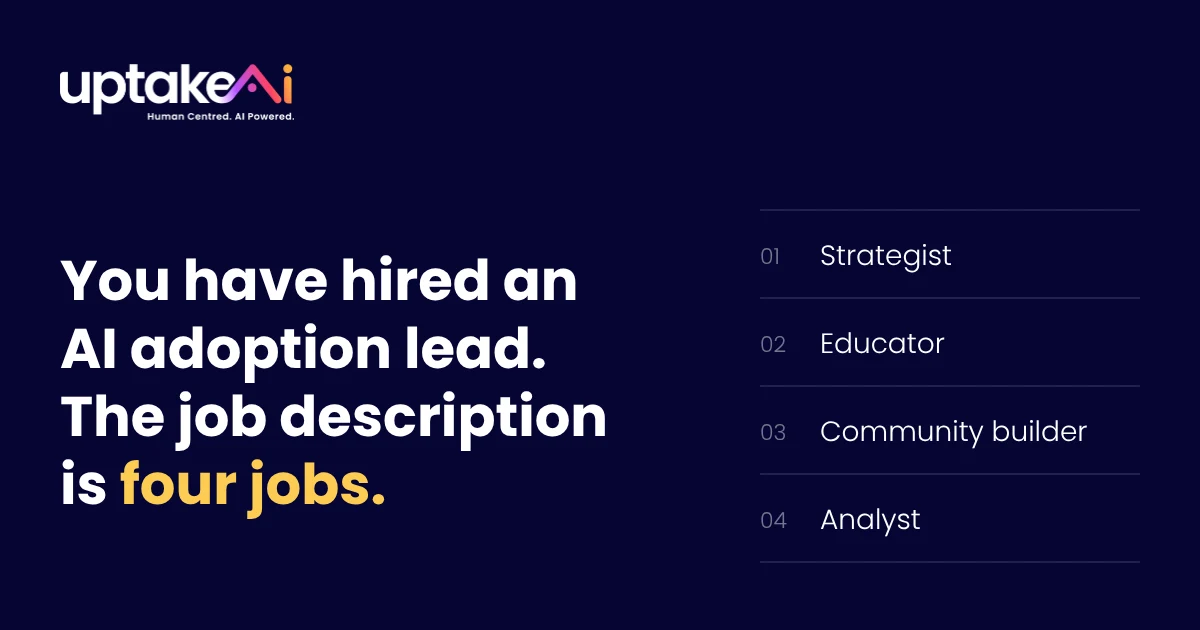
You have hired an AI adoption lead. The job description is four jobs.
We read five weeks of UK adverts for AI adoption roles. One person is asked to be strategist, trainer, community builder and analyst, and nobody agrees where they sit.
Somewhere in your organisation, someone has signed a requisition for an AI adoption lead. That is good news. Whoever signed it has accepted that buying the tools was the easy part, and has put a name and a budget against the harder part.
Then the job description arrives, and it is worth reading closely.
What we read
For five weeks to 19 October 2026, we ran the same three LinkedIn searches every week for UK adverts built around AI adoption, AI enablement and AI champions. We sorted each advert by who was hiring. Consultancies, recruiters and software vendors went into their own piles. What remained were organisations hiring for their own workforce: 68 distinct organisations across the five weeks. We read the adverts themselves, in full wherever we could reach them.
A note on the numbers. LinkedIn doesn’t show every advert, only a changing selection each time we search, so the figures below are the minimum we found, not a full count. Five weeks is also a short period. However, the patterns that repeated week after week are more reliable than any single total. It is also worth saying that consultancies and vendors were as numerous as employers in most weeks, which tells you something about how crowded the phrase “AI adoption” is becoming.
One person, four jobs
Strip the title from a typical advert and one post holder is asked to do four separate jobs.
The first is strategist. They are asked to write and run the change plan, and in the best adverts to “diagnose the cultural and behavioural barriers that exist in relation to AI” and design interventions to address them. The second is educator. They will “lead structured AI learning for colleagues across roles and confidence levels”, build the curriculum, run the sessions and provide desk-side support. The third is community builder. Almost every advert asks for a champions network or a community of practice, which means recruiting volunteers, keeping them motivated and giving them something worth doing. The fourth is analyst. They must track adoption and benefits, usually described as active and sustained usage, productivity, quality and colleague confidence.
Many adverts add a fifth, which is technical deployment: configuring the tools and liaising with engineers. Each of these is a profession in its own right. Change management, learning and development, internal communications and benefits analysis do not usually live in one head. We are asking one person to be all of them, usually on a fixed term, often without a team.
The contract shape adds pressure. Several of the adverts we read were fixed term, at 12 and 24 months, which means the lead has a clock as well as a brief. Adoption is not a project with a clean end date. It is a change in how people work, and that rarely lands on the schedule the contract assumes.
Nobody agrees where they sit
The reporting line is the clearest sign that organisations have not settled what adoption is. Of the 68 organisations, 29 placed the role in IT and digital. Nine placed it in HR and people, ten in transformation or an executive office, and two in communications. Eight embedded it in a single business function, four were unclear, and in six we could not establish the line.
Put the people-facing homes together and you have 21 organisations against 29 on the technology side. The ordering flipped several times in the first month as the sample grew, which is a fair summary of the market. Nobody has a settled answer.
This matters because the home shapes the job. Technology-side adverts lean towards measurement: licences, active users, benefits realised. People-side adverts lean towards behaviour: confidence, capability, change. Often both appear in the same advert, and neither side tells the post holder how to reconcile them.
The instrument is missing
This was the finding that struck us most. The adverts ask the post holder to identify capability gaps and adoption barriers, and then almost none of them says how. There is no named method for reading why some colleagues use the tool and others do not. The measure that does appear is usage, and usage tells you who opened the tool. It cannot tell you why everyone else did not.
The buyers can sense the problem. One advert asks for “experience supporting adoption and business change, not just classroom delivery”. Another says the role’s success is “adoption, not building”. Both are written by people who have seen a rollout that was technically delivered and quietly ignored. Neither advert says where the evidence for the diagnosis will come from.
What one person cannot change
A good adoption lead can run excellent training, build a network that lasts and report the numbers honestly. What they cannot do alone is change the conditions the tool lands in. Whether managers protect time to learn. Whether the climate makes it safe to try something and get it wrong. Whether people can see how the tool helps their own role. How threatened they feel by it. Whether they believe they can do it.
These are the five Cs we measure in PRISM: Conditions, Climate, Contribution, Concern and Capability. They sit in the organisation, not in the post holder’s remit, and they are largely invisible in usage data. If nobody reads them first, the new lead spends the first six months discovering them by trial and error, and the fixed term runs out before the discovery pays back.
Consider what that does to the first quarter. A lead who arrives without a diagnostic has two choices. They can start delivering training immediately, because that is visible and it is what the advert describes. Or they can spend weeks working out where the resistance actually sits, while the sponsor wonders what they are doing. Most take the first route, and it is the sensible choice given how they are being judged. It is also how organisations end up with excellent training and flat usage.
Before the advert goes out, or if it already has
Four things are worth doing.
First, decide which of the four jobs is the job. If the answer is all of them, split the work and pair the lead with learning and development, communications and an analyst, even if those are part-time contributions from existing colleagues.
Second, choose the home deliberately. IT and digital and HR and people can both work. What does not work is a lead with a home on one side and no sponsor on the other.
Third, read the conditions before you set the targets. Ask colleagues, not logs. A target of 60 per cent active use means little if you do not know whether the missing 40 per cent lack time, permission, relevance, confidence or something else.
Fourth, define what adopted means beyond usage, and agree it with the lead on day one. If the only agreed measure is how many people opened the tool, that is what they will be held to, and it is the wrong thing.
Hiring an adoption lead is a sensible response, and it is a sign that an organisation is taking the people side seriously. It works best when the lead walks into a clear picture of the conditions, not a blank page.
If you would like to understand the conditions your adoption lead will be working in, contact us to discuss your organisation’s PRISM read. If you want a personal read first, PRISM Portrait is on the uptakeAI website for you to try now.
Where does your organisation actually sit?
PRISM answers with evidence rather than opinion.
Explore PRISM